

Financial sustainability requirements for TEC-funded private training establishments
Te whakaatu whaihua ā-pūtea mō ngā whare whakangungu motuhake e utua ana e te TEC
This page explains our financial sustainability requirements for TEC-funded private training establishments (PTEs).
This page explains our financial sustainability requirements for TEC-funded private training establishments (PTEs).
On this page:
- Solvency and financial viability
- Financial documents PTEs must send us
- Our approach
- Financial monitoring framework (formulaic assessment)
- We then consider any other factors to determine the perceived risk
- Our approach with medium and high risk PTEs
- Management reports (medium risk)
- Action plan (high risk)
- Confidentiality of information
To receive Tertiary Education Commission (TEC) funding, a PTE must demonstrate that it can deliver its approved qualifications in a financially sustainable manner. This ensures the PTE sector maintains a robust financial footing, which:
- minimises the risks to learners and to the TEC of any future failures
- provides additional assurance to students that the PTEs they enrol in are viable
- provides greater assurance and security over the use of public funding.
The approach and methodology outlined below describes the assessment process we use to complete a limited scope desk-based review.
Solvency and financial viability
Under the Companies Act 1993, an organisation is solvent if it:
- can pay its bills when they are due, and
- has assets that exceed its liabilities, ie, has positive equity.
In practice, we define financial sustainability as an organisation’s ability to generate enough income to:
- meet operating payments
- meet debt commitments, and
- where applicable, to allow growth while delivering quality training and assessment.
We expect PTEs to be financially viable separate from their owners. Financial support from shareholders is acceptable short-term, but long-term ongoing financial support is not considered financially sustainable.
Financial documents PTEs must send us
We require financial information from every PTE that receives more than $50,000 in TEC funding. PTEs must provide:
- the financial statements for the last financial year (including a statement of financial performance, a statement of financial position, a statement of cash flows (where prepared), and any associated notes. The financial statements must be:
- reviewed by an independent Chartered Accountant where PTEs receive less than $5 million in TEC funding
- audited where PTEs receive $5 million or more in TEC funding in the current year. Where statements are audited to meet other statutory or organisational requirements (eg, charitable organisations) this meets our requirements
- the approved prospective financial information for the current financial year, including:
- a full-year forecast of the statement of financial performance
- a statement of financial position
- a statement of cash flows (where prepared)
- details of any major assumptions used to prepare these reports.
- a completed financial ratios spreadsheet (available at Calculating TEC financial ratios (XLSX 30 KB)).
PTEs must provide these reports each year within five months of their balance date. Not providing them is a breach of funding conditions and can place ongoing funding at risk.
Information should be sent to teifm.info@tec.govt.nz.
Our approach
We use a graduated approach to risk assessment, monitoring and reporting, which considers:
- the amount of TEC funding a PTE receives
- the provision it offers
- its financial performance and position
- its assessed financial viability (FV) risk rating (both historically and in future), and
- its educational performance.
This approach allows us to focus on those PTEs of greatest significance from an educational, funding and financial viability perspective.
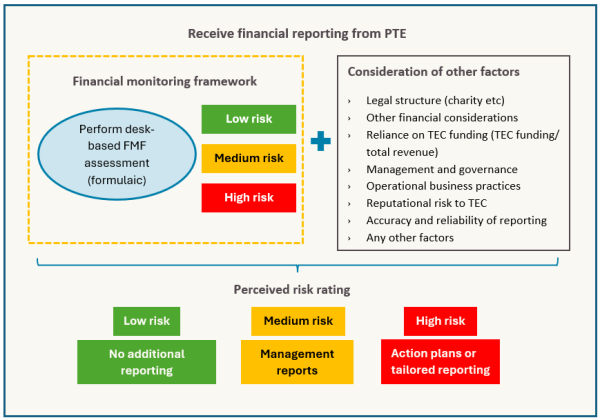
We assess the financial sustainability of PTEs using both quantitative and qualitative information. We make a formulaic assessment of financial information through a financial monitoring framework (FMF), then consider any other information available to us in relation to operational, educational or management risks.
Using both the FMF indicators and other information, we then determine a perceived risk rating for each PTE. This process is illustrated in Figure 1.
We use the perceived risk rating for TEC investment purposes and to determine whether we require any additional reporting or monitoring to manage the level of risk.
Figure 1: TEC risk assessment process for PTEs
Financial monitoring framework (formulaic assessment)
We use financial indicators to assess the financial performance and position of the PTEs we fund. We score a PTE against each indicator and determine an overall score, which places the PTE into one of three risk categories. We expect each PTE we fund to meet all the minimum prudential financial standards and to have an average score of over 2.5 each year.
Table 1: Risk categories and characteristics
| Category | Average score | PTE characteristics |
|---|---|---|
| Low risk | > 3.0 | Meets expectations against most financial viability indicators and does not raise any major concerns. |
| Medium risk | 2.51–2.90 | Exhibits some poor financial results, which could impact on future financial viability. We may require some increased monitoring to ensure Crown funding is not at risk. |
| High risk | < or equal to 2.50 | Not performing well against financial viability indicators. Closer assessment of the financial performance and position is required. Action plans need to be considered. |
For more information on how we score each ratio, see Process for scoring the TEC financial ratios (DOCX 61 KB).
We then consider any other factors to determine the perceived risk
This is a subjective assessment of wider risk factors (which requires professional judgement). We fund a large number and different types of PTEs, so a perceived risk assessment allows us to consider any other factors (or strategies that a PTE is trying to implement), given its entity type and for profit/charitable status to determine an overall suitable risk rating.
In determining a perceived risk level, we will outline the factors we consider are either elevating or reducing a PTE’s financial sustainability risk.
Factors we may consider include (but are not limited to):
- high reliance on TEC funding as a percentage of total income
- low values of delivery within Single Data Return (SDR) reporting or fund reporting
- historical poor financial and delivery forecasting accuracy
- declines in performance
- funding allocations
- management or governance concerns
- compliance concerns
- reputational and regulatory issues
- broader sector trends.
These factors will vary on a case-by-case basis and are most likely to impact those PTEs that are assessed as a high FV risk via the FMF. You will have an opportunity to respond to these factors and provide any information that you think is relevant for our assessment.
If we do not need to consider wider factors in our assessment, we will report the PTE’s FV rating only. We will clearly communicate this to you.
Examples of considering other factors
Two examples where a PTE’s perceived risk may change from its assessed FV rating are:
- Low FV rating but medium (or high) perceived risk – this may occur when a PTE has a strong balance sheet and is profit making, but other factors such as compliance-related reporting, issues with quality of delivery, or reputational issues (such as an active investigation) mean the PTE poses elevated risk to the TEC. We are likely to request additional reporting, such as post-balance-date management reports or action plans.
- High FV rating but low perceived risk – where a PTE fails to meet key financial indicators, such as operating in a deficit position (placing pressure on profitability and cash flow metrics), but this is in accordance with a documented strategy and the PTE has a strong balance sheet to support the current operating position, there is a low overall risk to TEC and learners. This is often the case for the charitable entities the TEC funds.
Separately, if we require and accept a repayment plan, then the PTE will be considered high risk.
Our approach with medium and high risk PTEs
When we assess any PTE we fund as medium or high risk, then we are likely to:
- advise the PTE of the issues that led to our concerns, and the steps that may be required to address those issues
- ask its governing body (ie, directors or Board of Trustees) to supply us with more regular financial reporting (typically management reports used to track organisational performance), or
- request an action plan that details the actions they will take in order to meet our financial viability requirements, and when these will occur.
A high-level summary of the possible reporting requirements is set out in Table 2. The actual reporting that we request will reflect each PTE’s underlying circumstances and the seriousness of our concerns.
Table 2: Summary of possible outcomes and reporting requirements
| FV rating (formulaic FMF) | Perceived risk (subjective assessment) | Additional reporting requirements |
|---|---|---|
| Low risk | Low | N/A |
| Medium | Situation-dependent. Specific report tailored to TEC concerns | |
| High | ||
| Medium risk | Low | N/A |
| Medium | Management reports | |
| High | Action plan | |
| High risk | Low | N/A |
| Medium | Management reports | |
| High | Action plan |
Management reports (medium risk)
The management reports allow the PTE and the TEC to compare the PTE’s actual financial results with their forecasts submitted to the TEC as part of their annual financial submission. We typically ask for management reports that show nine months of actual performance and a three-month re-forecast for the rest of the financial year. Where possible, we accept management reports already prepared by a PTE for internal reporting to avoid duplication in reporting.
We expect the management reports to include the following, as well as a comparison to the forecast information previously provided:
- statement of financial position
- statement of comprehensive income
- statement of cash flows.
Action plan (high risk)
The action plan template is available at TEC action plan template (DOCX 97 KB). At a high level, an action plan for a PTE should set out:
- the identified issues and their causes
- the actions and strategies you will undertake to address the causes of the problems
- any extra capability or resources you require to help with these tasks
- a timetable for key decisions and actions and the target dates to implement the chosen options. While some financial issues take time to remedy, actions should focus on the next 12 months
- confirmation from your governing body that you will put the action plan into effect, maintain any changes over the year and resolve and maintain the financial issues in future
- a re-forecast (profit & loss and balance sheet) which incorporates the effects of any planned changes.
Your governing body will need to ensure the action plan is put into effect and report on the achievement of the action plan activities. We recommend that you provide a progress report at the end of the financial year.
There may be various ways to address the issues identified. Your organisation should choose how it will address any issues. Any proposed solution must, however, be effective, and you must maintain it in the future.
We will accept a letter from your governing body that confirms they will continue to commit to meeting the TEC financial viability requirements on an ongoing basis, where you can demonstrate that actions already taken address the financial issues we identified.
If you have any questions about the action plan requirements, or want feedback on the acceptability of a draft plan before your directors formally adopt it, email teifm.info@tec.govt.nz.
Our acceptance of your action plan
We will confirm acceptance of the plan or let you know if the plan needs amendments for any reason.
We may require you to provide progress reports on the achievement of the plan and of any key milestones. We may also propose follow-up financial monitoring arrangements to see that the plan is achieved, and the PTE continues to meet TEC’s financial viability requirements.
We will exercise judgement in determining whether a risk exists and whether the PTE has adequately mitigated that risk. This will be determined on a case-by-case basis. Any decisions exercising judgement will be made by qualified accountants, based on suitable evidence.
When making future funding decisions we will consider the action plan, and information covering achievement of performance against the action plan.
PTEs should note that failure to meet the TEC financial viability requirements may affect funding in the future. We reserve the right to act, at any time, to protect student interests or public funds.
If you initially meet our financial viability requirements but later fail to meet them, we expect you to keep us informed, and take action to ensure ongoing compliance with these requirements.
Confidentiality of information
We are governed by the relevant provisions of the Official Information Act (OIA). We recognise that PTEs provide commercially sensitive information as part of our financial monitoring process, and we treat this information in confidence. There are provisions in the OIA that recognise the need for the protection of commercial and confidential information.
We treat all financial information we receive as part of the PTE assessment process as “commercial, in confidence”. We collect this information for financial viability assessment purposes only. The information may be shared within the TEC. We have reciprocal arrangements with the New Zealand Qualifications Authority (NZQA) and may share the information with NZQA, on a confidential basis, if NZQA is concerned about a PTE’s financial viability.
We do not publicly release risk ratings of individual PTEs.