

Universal Design for Learning (UDL)
Universal Design for Learning (UDL)
UDL is a framework for designing inclusive learning activities, based on neuroscience and evidence-based educational practices. It promotes flexible environments where all learners have equal opportunities.
UDL is a framework for designing inclusive learning activities, based on neuroscience and evidence-based educational practices. It promotes flexible environments where all learners have equal opportunities.
On this page:
- What is Universal Design for Learning (UDL)?
- The goal of UDL: learner agency
- The UDL guidelines
- The UDL thinking cycle
- More resources for educators
Not everyone engages with and processes information in the same way. Every learner is unique and so are their learning preferences. So, how do we ensure we create inclusive, flexible learning environments where people of all abilities can thrive? That’s where Universal Design for Learning comes in.
What is Universal Design for Learning (UDL)?
A framework based on neuroscience and evidence-based educational practices, UDL offers a proactive approach to designing inclusive learning activities. Developed by CAST, a US non-profit organisation, UDL promotes flexible teaching and learning environments where all learners have equal opportunities.
Universal design – design intended to be accessible to everyone – can exist anywhere, not just in a learning environment. For example, an institution might decide to build a ramp to its entrance rather than stairs. That makes it easier for people with disabilities to access the facility, and is also beneficial for people delivering supplies, the elderly or people with prams. The entrance is designed to be multi-purpose, taking into consideration everyone’s needs, not just one group.
For UDL to work, educators must reflect on their beliefs, skills, and systems for teaching learners, breaking away from rigid, one-size-fits-all models of education. The UDL framework helps teachers anticipate and address barriers to learning, and comprehensively cater to all learners.
The goal of UDL: learner agency
UDL isn't about framing the issue as a learner's perceived shortfall, but about rethinking how we design teaching and learning to ensure all learners can engage in meaningful education. Nor is it a “one-and-done” solution. It calls for the relationship between educator and learner to be regularly assessed, creating a nurturing environment where learners can make sense of material individually and collectively.
UDL helps foster learner agency by supporting learners to be:
- purposeful – learners believe they can succeed and act in ways that are personally and socially meaningful
- reflective – learners understand what motivates them and what helps them learn, and can make adjustments when needed
- resourceful – learners understand and can apply their strengths, skills and resources
- authentic – learners understand what it means to bring their whole self to the learning
- strategic – learners set goals and keep track of their progress with a clear plan
- action-oriented – learners take charge of their own learning and work with others to achieve their goals.
The UDL guidelines
The guidelines below show how the UDL framework can be implemented. They aim to support educators, curriculum developers, researchers, parents and others in applying UDL to real-world settings.
UDL acknowledges that we learn differently across three primary networks in the brain:
- Affective networks influence our emotions and motivations.
- Recognition networks influence what we perceive and understand through our senses.
- Strategic networks influence how we organise and communicate our thinking.
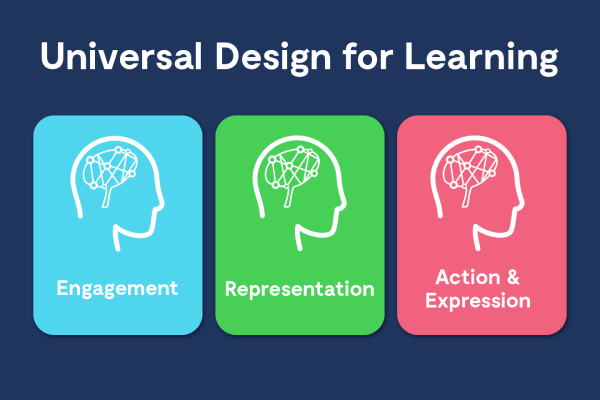
From this, three principles were developed that underpin the framework and acknowledge that how we perceive information, express ourselves, and engage with learning differs:
Engagement aims to offer learners a range of options to support their interest, motivation and resilience. It guides the design of learning environments that are safe, relevant and supportive of learners’ motivation and resilience.
Representation focuses on how we recognise, make meaning from and use information. It also focuses on presenting information in different ways to support everyone’s access and understanding.
Action and expression is about providing options and support so everyone can learn, create and share in ways that work for them.
These principles help to foster respectful, inclusive environments where everyone is learning and achieving and where diversity is seen as a source of strength.
Learn more about the UDL guidelines on the CAST UDL Guidelines website.
The UDL thinking cycle
There are several approaches to applying UDL, including the UDL Thinking Cycle. The cycle offers a step-by-step process for educators to follow in their planning.
Step One: What do we know about the people and context?
Ask yourself, what do we know about the learner? Include:
- cultures, languages and identities
- connections to place
- strengths and passions
- prior knowledge and experience
- specific needs and preferences
- what’s "on top"
- wellbeing and morale.
Ask yourself, what do we know about the context? Include:
- time of day, time in the week
- environment (eg, online, face-to-face, field trip)
- familiar or unfamiliar activity or setting.
Step Two: What’s the goal and purpose?
Ask yourself:
- What is the goal?
- Why are we doing this?
- What could success look like?
- Can these be co-designed with learners?
Step Three: Identify possible barriers to learning in the design
Ask yourself, what in our design or how we teach and communicate could create inequality and discrimination or get in the way of learning?
Think about possible barriers to:
- engagement and motivation
- accessing and understanding information
- participating in learning and expressing knowledge.
Step Four: Identify universal supports
Ask yourself, what supports, options and tools can we make available to everyone?
- Build 1:1 or differentiated approaches and supports into the design.
- Include approaches that have worked well in the past.
- Include approaches that support wellbeing and belonging, such as kai, music, an organised space and cultural practices.
Step Five: Make a plan supported by UDL guidelines
Make and implement a plan to support learner variability across all three UDL principles (Engagement; Representation; Action and Expression):
- Allow what you know about your learners to influence the design.
- Address key barriers.
- Build in useful options and universal supports aligned to the three UDL principles.
- Consider how to get feedback.
Step Six: Teach, evaluate, revise
Ask yourself:
- What options, universal supports and strategies worked well?
- What didn't work so well?
- What did the feedback highlight?
- What will I try next time?
Learn more about the UDL thinking cycle at Universal Design for Learning (UDL) – NCEA Education.
More resources for educators
Everyone deserves equal opportunity and access to learning. Universal Design for Learning is a solution that fosters inclusive environments where learners have agency over their own learning.
The approach is an ongoing process requiring a commitment to practice, adjustment and refinement. No two brains are the same, and UDL offers a scientific, experience-backed approach to learning that empower learners collectively and helps develop world-class educators.
Articles and information:
- UDL and the Learning Brain – CAST
- Universal Design for Learning – CAST
- Universal Design for Learning: A teacher's guide – Understood
- How to break down barriers to learning with UDL – Understood
- UDL Educator Pathway – Pathways Awarua
Videos: