Starting Points Reading – LNAAT
Ngā Pūwāhi Tīmata mō te Pānui – LNAAT
This page has information about Starting Points Reading, the online adaptive assessment option.
This page has information about Starting Points Reading, the online adaptive assessment option.
What is Starting Points Reading?
Starting Points Reading is one of two online, adaptive assessment options designed for learners who are at or below koru/step 1 of the Learning Progressions for Adult Literacy. This option is based on the Starting Points Assessment Guide and focuses on reading.
To complete Starting Points Reading, a learner must understand a range of spoken and written English, including basic questions and directions. Therefore, this option is not suitable for English language (ESOL) learners who are at very early stages of learning English.
Starting Points Reading is suitable for learners who are at foundation stages of learning to read. These include both ESOL learners and those who have grown up in Aotearoa New Zealand and have English as their first language. Some of these learners are likely to have reading and/or other learning differences.
Starting Points assessments are designed for use in a supported one-to-one situation, ideally using a tablet. More confident learners may be able to complete the assessments independently on a tablet, PC or laptop. A key feature of the Starting Points options is that the learners listen and respond to spoken language. In a group situation, learners may need to use headphones so as not to disturb others.
What do we need to know?
Starting Points Reading provides information about a learner’s level of ability in the foundational skills for learning to read. These include the "building blocks" of reading and writing:
- phonological awareness
- letter-sound relationships
- vocabulary.
Phonological awareness is a vital first step in "cracking the code" of written language. Because it's about hearing the sounds of the language rather than reading them, it's usually assessed in a face-to-face situation. However, the audio-based format developed specifically for Starting Points Reading allows aspects of phonological awareness to be assessed online.
- Information from Starting Points Reading may provide educators with an indication of areas in which further diagnostic or specialised testing might be appropriate, for example, to support learners with reading difficulties.
- Starting Points Reading covers the range from foundational skills to koru/step 2+ on the Learning Progressions for Reading. At koru/steps 1 and 2+, the focus changes to reading vocabulary and comprehension. A score at step 2+ indicates that a learner may be ready to transition to the mainstream reading option in the Literacy and Numeracy for Adults Assessment Tool (LNAAT).
- You'll find the Starting Points assessment home page at https://assess.literacyandnumeracyforadults.com/StartingLogin.aspx
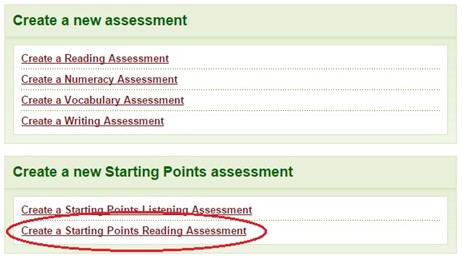
- Starting Points assessments are created via the link on the home tab and the assessments tab.
- Starting Points Reading assessments have a new "discontinued" feature that ends the assessment after seven incorrect answers. (Note: A "discontinued result" is a valid result for both funding and educational purposes.)
Creating a Starting Points Reading assessment
Starting Points Reading assessments are created in a similar way to Starting Points Listening assessments and are only available online.
To create a Starting Points Reading assessment, click on the appropriate link on either the home tab or assessments tab.
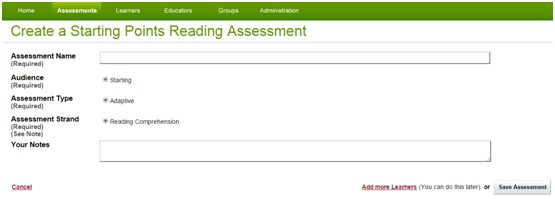
You can then create an assessment in the usual way. Note: Audience, Assessment Type, and Assessment Status are fixed values.
Sitting a Starting Points Reading assessment
Learners will sit their assessments online using a six-digit alphanumeric code. When they enter their code into the LNAAT they are taken to the Starting Points homepage.
When the learner clicks "Start" they are prompted to confirm their name and then start the assessment. Starting Points assessments do not use practice questions.
Audio note: Many Starting Points Reading items include audio. Audio components are signalled by either a "speaker" icon or an "ear" icon. Learners click on/touch these icons to hear the audio.

The speaker icon indicates that support audio is available. Clicking or touching this icon lets the learner listen to supporting audio (usually a spoken version of an instruction or question).

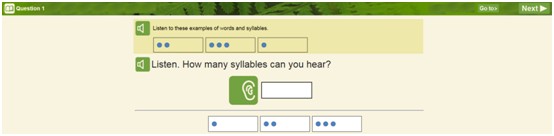
The ear icon indicates that the learner must listen to the associated audio file to be able to answer the question.
Learners are asked four main types of questions:
1. Multichoice: The learner selects one of three or four options.
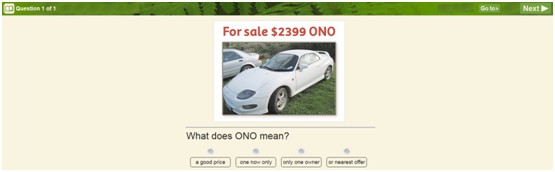
2. Matching: The learner selects the correct match (or matches) from a number of options.
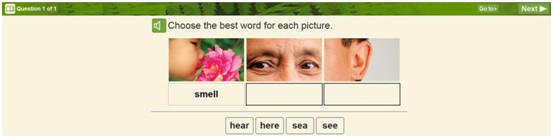
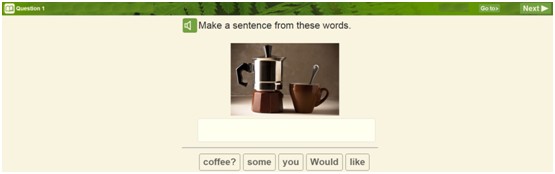
3. Sequencing: The learner puts several words or letters into the correct order.
4. Syllables: This question type includes some supporting examples. Learners can play these as often as they wish. To answer the question, learners must listen to a word played and choose whether it has one, two or three syllables by selecting the option with the corresponding number of blue dots.
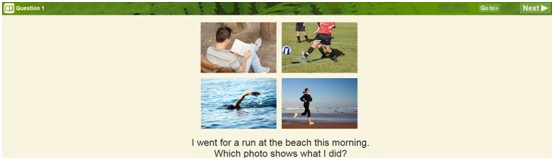
5. Image Grid: Learners must select the picture that best answers the question.
At the end of a Starting Points Reading assessment the learner is able to view their results.
Starting Points Reading scale scores and steps
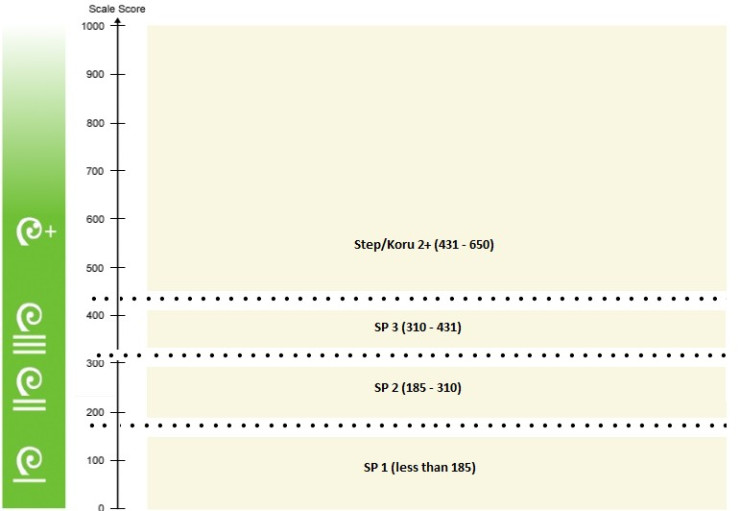
Starting Points Reading has been mapped on to the same 1,000-point scale as the existing Reading option. This means that it essentially provides more gradation to what is otherwise known as step 1 in the Adult, Youth and Te Ata Hāpara reading assessment options. A learner cannot score more than approximately 650 on a Starting Points Reading assessment.
There are four steps within Starting Points Reading: Starting Points (SP) 1, SP 2, SP 3, and step/koru 2+. Once a learner achieves a scale score of more than 600, they may be ready to move on to one of the other reading assessment options.