

Enrolment – DQ7-10
Whakaurunga – DQ7-10
This page has information about Delivery at Levels 7 (degree) to 10 on the New Zealand Qualifications and Credentials Framework (DQ7-10) Fund learner admission and enrolment, verification of learner identity and eligibility, payment and refund of fees, confirmed learner enrolments, and learner withdrawals.
This page has information about Delivery at Levels 7 (degree) to 10 on the New Zealand Qualifications and Credentials Framework (DQ7-10) Fund learner admission and enrolment, verification of learner identity and eligibility, payment and refund of fees, confirmed learner enrolments, and learner withdrawals.
On this page:
- Enrolment requirements
- Course withdrawal, programme withdrawal and fees refund
- Learner-centred provision
- Fees refunds
- Recognition of prior learning/achievement (RPL) and credit recognition transfer (CRT)
- Tuition fees
Enrolment requirements
Enrolment restrictions
You may restrict the number of eligible learners who can enrol in a programme or micro-credential in accordance with Section 255(4) of the Education and Training Act 2020.
We recommend that you determine and publish:
- the maximum number of learners who can enrol each year in a programme leading to the award of a qualification or course, and
- your criteria and processes for selecting learners for the restricted entry programmes or courses.
You may:
- set minimum entry standards
- require a learner to achieve satisfactory academic progress
- require completion of another qualification first, and/or
- set admission limits (for example, capped numbers of high cost DQ7-10 provision such as dentistry and aviation).
You must not restrict enrolment in a DQ7-10 funded programme on the basis of private advantage (for example, restricting enrolment to the tertiary education organisation’s employees only).
Enrolment form
An enrolment form should collect all information that you are required to report in the Single Data Return (SDR).
To identify all the information that you are required to collect, see the Data Specifications for the Single Data Return (SDR).
You may also use the generic enrolment form (DOCX 79 KB). We recommend that you publish your enrolment form.
Privacy statement
Once you have assessed a learner as eligible, you must provide them with a privacy statement explaining that you are holding their personal information for specified purposes and that you may have disclosure obligations.
See our privacy statement requirements for tertiary education organisations (TEOs) in the Base Funding Conditions, and if useful, or adapt the TEC template privacy statement.
Enrolment application
To enrol in a programme leading to the award of a qualification, the learner needs to apply to you by:
- completing and submitting your enrolment form, and
- providing evidence so you can verify their identity, and determine their eligibility.
Enrolment process
We recommend that your admission and enrolment process for DQ7-10 includes the steps below:
| Step | Responsibility | Action |
|---|---|---|
| 1 | You (TEO) | Provide information on qualification programmes of study (including courses), the admission and enrolment process, and the withdrawal and fees refund process (including any impacts on learner eligibility for final-year fees-free tertiary education in the future). |
| 2 | Learner | Applies to you for admission and enrolment (separately or together). |
| 3 | You | Verify the learner’s identity. |
| 4 | You | Confirm the learner’s eligibility to study (and eligibility for provision funded through DQ7-10). |
| 5 | You | Recognise prior learning. |
| 6 | You | Make a formal offer to enrol the learner on a course or programme, excluding recognised prior learning. |
| 7 | Learner | Formally accepts the offer. |
| 8 | You | Record the enrolment in your student management system. |
| 9 | You | Invoice the learner for any tuition fees and charges, including any student services fees (SSFs) adjusted post-recognised prior learning. See Student services fees. |
| 10 | Learner | Pays any tuition fees and charges, or arranges for them to be paid. |
| 11 | You | Record payment of any tuition fees and charges, and apply the relevant Student Fee Protection arrangements, as applicable. |
| 12 | You | Provide the learner with information about all planned learning activities in their programme. |
| 13 | You | Provide refunds for learners who withdraw from courses within the defined withdrawal period for fees refund and record these refunds. |
| 14 | You | Record the learner as a confirmed learner enrolment once the fees refund period has passed. |
| 15 | You | Record the learner as a valid domestic enrolment once the 10% or one month (whichever is earlier) period for eligibility for TEC funding has passed. |
We expect you to inform each learner during the enrolment process about all planned learning activities leading to the award of the qualification the learner has enrolled in. “Planned learning activities” includes self-learning activities you expect the learner to engage with/participate in. It does not include self-directed activities the learner initiates.
Also note that there are additional enrolment requirements under the New Zealand Qualifications Authority (NZQA) rules and the Tertiary and International Learners Code of Practice.
- NZQA rules
- Education (Pastoral Care of Tertiary and International Learners) Code of Practice 2021 – NZQA
Admission
We expect you to publish admission information before the start of each programme.
This information should include:
- admission requirements
- tuition fees and other course costs
- criteria and process for selecting learners for entry into restricted entry courses (if relevant)
- criteria and process for assessing and recognising a learner’s prior learning
- criteria and process for cross-crediting courses across multiple qualifications
- documents that a learner must submit (for example, a learner’s academic transcript or record from another TEO)
- the enrolment process
- minimum attendance and code of conduct requirements
- withdrawal requirements and process, including refunds
- learner support services available, and
- student services fees (SSFs) information in accordance with the relevant funding conditions on SSFs.
For requirements for tertiary education institutions (TEIs) and registered private training establishments (PTEs) to provide information about fees, see the funding conditions for the relevant year and the relevant data specifications.
Enrolment changes
If a learner’s enrolment changes for any reason, you must update your records to reflect the changes. We recommend you also send updated enrolment information to the learner.
Confirmed learner enrolment
All DQ7-10 funded TEOs must report all confirmed learner enrolments with a programme start date on or after 1 January in the SDR. For the definition of a confirmed learner enrolment, see the funding conditions for the relevant year.
Confirmed learner enrolments apply to programme, course and micro-credential enrolments where fees apply, including student service fees (SSFs). This ensures we gain a wider understanding of TEO enrolments by including enrolments where the TEO receives fees from a learner and does not refund the fees after a withdrawal.
You must ensure that your SDR accurately records all “confirmed learner enrolments” where fees apply. A confirmed learner enrolment occurs where:
- a learner and your organisation have entered an enrolment/tuition contract (or training agreement/other arrangement) and the learner (or their employer) has paid or committed to pay their fees, and the withdrawal period (eg, when a full refund of fees, less any administration fee, is available) has passed, and
- the learner has not received a full refund of fees (less any applicable administration fee).
Course withdrawal, programme withdrawal and fees refund
Withdrawals
A withdrawal is when a learner stops participating in a course, programme or micro-credential (whether or not any fees are refunded), either by notifying you that they wish to withdraw from participation, study and/or enrolment, or through non-attendance or non-participation for any reason.
Disengaged learners who have not formally withdrawn
If a learner stops engaging (eg, no attendance in face-to-face classes or no online log-ins), confirm with them as early as possible whether they are intending to withdraw.
If you continue to report the enrolment and it is unsuccessful, it will be counted as a course non-completion for your Educational Performance Indicators (EPIs).
Setting a withdrawal date
You must record a withdrawal date in your Single Data Return (SDR) for any withdrawn enrolment, and make required notifications (eg, StudyLink).
For the requirements for withdrawal dates for TEIs and registered PTEs, including reporting withdrawals to StudyLink and other parties, see the funding conditions for the relevant year.
You cannot receive funding for an enrolment with a withdrawal date that occurs before 10% or one month of the course (rounded up to the nearest whole day), whichever is earlier.
Learner-centred provision
Learners wanting to defer their start date
You may agree to defer a learner’s enrolment start date, but you should have a policy for the circumstances under which a learner may do this.
No DQ7-10 funding can be claimed until the learner has started their study and the 10% or one-month date for accessing funding has passed.
Learners wanting to accelerate their study (undertake additional learning)
Learners may only be enrolled in additional course/s or qualifications when they have chosen to accelerate their programme of study or training. This may result in them exceeding one equivalent full-time student (EFTS) in a year.
For example, a learner may choose to complete a three-year qualification in two-and-a-half years by undertaking a higher than usual course load each year.
In those cases, we expect additional learning hours to be matched by appropriate additional teaching hours.
Example: A qualification that is 34 weeks each year in length is generally 1.0 EFTS in value each year, which equates to 0.03 EFTS each week.
0.03 EFTS per week x 34 weeks = 1.0 EFTS.
If a learner studies for 52 weeks in a year, the maximum total EFTS that we will fund for the learner is 1.56 EFTS.
0.03 EFTS per week x 52 weeks = 1.56 EFTS.
Make sure the learner understands the workload required to complete their courses and qualification.
Inducement
An enrolment is not a valid domestic enrolment if the learner has been induced to enrol. We recommend that before offering items or activities linked to learner enrolment, you contact us to discuss this.
Fees refund period
You must apply a fees refund period. If a learner withdraws from a course or programme within this period, they must receive a refund of fees (or waiver of fee payment) and course costs (minus any administration fees).
Refund period requirements differ for registered private training establishments (PTEs) and tertiary education institutions (TEIs).
Course/programme withdrawal and fees refund practice (reporting)
Your withdrawal/fees refund practice can determine whether an enrolment must be reported as a confirmed learner enrolment under Source of Funding (SoF) 31.
The course enrolment must be reported under SoF 31, regardless of whether:
- the enrolment passes the 10% or one-month threshold for claiming TEC funding, or
- you do not claim funding for the course enrolment, or
- you retain some or all fees for the course enrolment.
In example 1 (below) this would mean that courses 1 and 2 would be reported under SoF 31 if fees are retained but no TEC funding is claimed.
Withdrawing by programme and retaining fees
Some TEOs (mainly registered PTEs) will withdraw a learner from the whole programme (or qualification) and retain all the fees for that programme, even though not all course start dates have been reached.
If you retain fees for courses where you don’t claim TEC funding, you must report these courses’ confirmed learner enrolments under SoF 31.
Withdrawing by course and retaining fees
Other TEOs withdraw by course, retaining fees only for courses that became a valid enrolment under SoF 01 (ie, after the 10% / one-month threshold). If you refund fees in full for courses not started or past the refund date, those enrolments are not confirmed learner enrolments at the point of refund.
Example 1: Refunding tuition fees when withdrawing learners by course or by programme
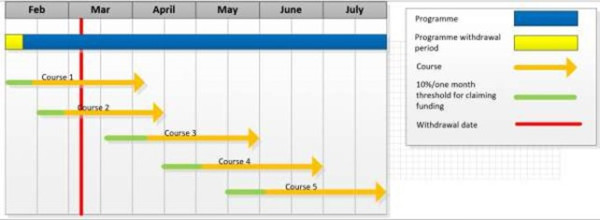
The tuition fees to be refunded to the learner will differ depending on whether the TEO withdraws learners by course or by programme.
By course: Refund the tuition fees for courses 3, 4 and 5 (their refund periods haven’t passed).
By programme: No refund of tuition fees is required as the fees refund period for the programme has passed. If no refund is given (excluding any administration charges):
- Enrolments for courses 1 and 2 will need to be reported under SoF 31 if no TEC funding is claimed (if funding is claimed, courses 1 and 2 must be reported under SoF 01).
- Enrolments for courses 3, 4 and 5 must be reported under SoF 31.
- Alternatively, if you fully refund the learner for courses 3, 4 and 5 (less any administration charges), these courses do not need to be reported.
Example 2: June withdrawal with staggered course start dates
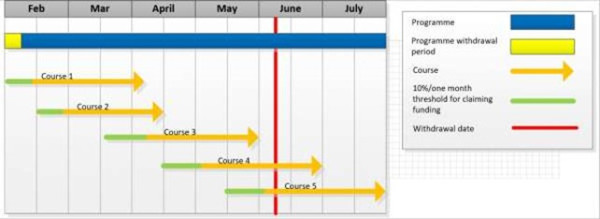
You do not need to refund fees in this scenario, as the refund period has passed for both the programme and courses.
Reporting:
- These courses would not need to be reported under SoF 31 and would instead be reported under the relevant SoF for a valid domestic enrolment (eg, SoF 01).
However, if you do not claim TEC funding and retain fees, you must report the course enrolments under SoF 31.
Example 3: Refunding tuition fees with same course start and end dates
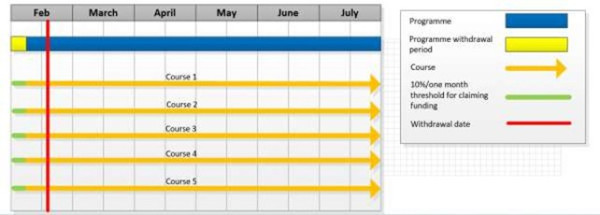
All courses in the programme share the same start and end dates, and the learner withdraws after the fees refund period for the programme and the courses.
Refunds:
- No refund is required because the fees refund period has passed for the programme and all courses.
- This outcome is the same whether you withdraw the learner by course or programme.
Reporting:
- If you claim TEC funding, report enrolments under SoF 01 for a valid domestic enrolment.
If you retain fees and do not claim TEC funding, report the course enrolments under SoF 31.
Reporting of withdrawals
We require TEOs to report enrolments where the TEO retains some or all the learner’s fee(s) if the learner withdrew after the fees refund period, if:
- the learner withdrew after the fees refund period, but before the enrolment became eligible for TEC funding, and
- the learner withdrew after the fees refund period, and after the enrolment became eligible for TEC funding, but the TEO is not claiming funding.
This requirement does not apply to:
- first-year fees free enrolments (course, micro-credential and/or programme), or
- enrolments where the learner has:
- not paid the fees by the due date/date committed to, and/or
- received a full refund of fees (course, micro-credential and/or programme) less any applicable administration fee.
The confirmed learner enrolments must be reported in the SDR under SoF 31 (if the learner had not withdrawn, the enrolments would be reported under SoF 01 for DQ7-10).
Example 4: How to report DQ7-10 course enrolments
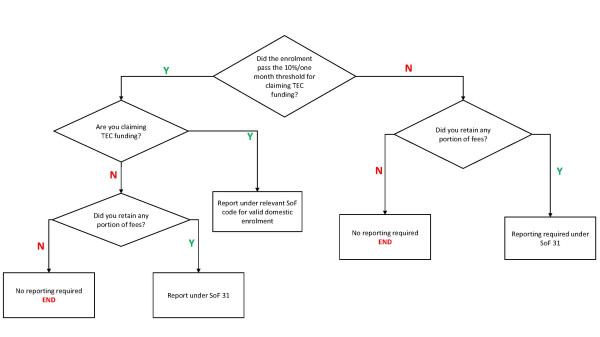
Scholarships
If you decide to pay for the learner’s fees through a scholarship after the learner has already paid, they remain a confirmed learner enrolment.
Educational Performance Indicators (EPIs)
Confirmed learner enrolments (reported under SoF 31) are included in EPI calculations.
Advising StudyLink and other parties of learner withdrawal
When a learner who is receiving a student loan and/or student allowance withdraws from study, the date of withdrawal that you must notify to StudyLink is the date you determined that the learner had ceased to participate (eg, for non-attendance or non-participation).
Notify StudyLink within 5 working days of each withdrawal (including partial withdrawals).
Example
- First date of non-attendance: 7 March
- Date you determined that the learner had stopped participating: 12 March
- Withdrawal date you advise to StudyLink, and report in the SDR: 12 March
- Notify StudyLink by 19 March 2025 (5 working days after 12 March).
Fees refunds
Refund when the enrolment changes
At enrolment clearly state to the learner how long they have to change their enrolment(s) or withdraw from a course or programme and still get a fees refund (less any administration charge).
- Process fees refunds promptly in a timely manner for the learner.
- Refund the learner in the way the original fee was paid – ie, if fees were paid through the Student Loan Scheme, the refund should be returned to StudyLink.
- Don’t hold the refund as a credit (eg, for the learner enrolling/re-enrolling at your organisation in the future) unless you can demonstrate that the learner has understood their refund entitlement and agreed to waive their entitlement.
Full fees refund
If you decide to refund all of a learner’s fees after the fees refund period has passed (eg, on compassionate grounds) they cease to be a confirmed learner enrolment and should not be reported in the SDR.
Part fees refund
If you decide to refund some of a learner’s fees after the fees refund period has passed (eg, on compassionate grounds) they remain a confirmed learner enrolment for the purposes of reporting to us and must be included in the SDR.
No fees refund
If a learner withdraws from their course (either formally or informally) or has been expelled after the fees refund period has passed, and no fees refund is made, they remain a confirmed learner enrolment for the purposes of reporting to us and must be included in the SDR.
These requirements also apply when you decide to pay for the learner’s fees through a scholarship.
Learners with unpaid fees
A learner is a confirmed learner enrolment only when they have paid or committed to pay fees and the fees refund period has passed.
If the learner does not pay their fees as committed, they cease to be a confirmed learner enrolment or a valid domestic enrolment. You must not claim DQ7-10 funding for them.
Recognition of prior learning/achievement (RPL) and credit recognition transfer (CRT)
RPL refers to previous study or experience (prior achievement) relevant to the programme the learner is about to enrol in or is currently studying. It enables a learner to progress without repeating parts of the qualification already achieved through prior study, work or other experience. RPL and CRT are forms of recognising prior learning/prior achievement.
For more information, see: Guidelines for the recognition and award of learning for credit – NZQA.
Your responsibilities
- Recognise each learner’s prior learning and adjust their programme (eg, removing courses already achieved).
- Evaluate early: identify whether the learner is likely to have the knowledge, skills and attributes that can contribute to the graduate outcomes of the qualification.
- Seek evidence of prior academic achievement, including using an NZQA Record of Achievement, when each learner enrols.
- If the learner has achieved course content previously, you must:
- work out the EFTS factor of their prior learning (relative to the standard course)
- subtract this from the standard course EFTS factor
- submit the revised EFTS factor in the enrolment file of the SDR, in the FACTOR field, for that learner.
You cannot claim DQ7-10 funding or learner fees for RPL or CRT, or for delivering tuition where the learner already has prior learning (ie, skills and/or knowledge).
More information on RPL or CRT is available at Recognition of learning for credit – NZQA.
If you have any questions, please contact NZQA.
Tuition fees
Invoicing
We expect you to provide the learner with an itemised invoice that clearly lists the fees and course costs for each course they are enrolled in.
The learner then pays the fees specified in the invoice or arranges for them to be paid.
Receipt
After you receive payment (or confirmation that payment has been arranged), issue a receipt to the learner.